Fragmented devices
Lighting, security, energy and sensors can each arrive with separate hubs, applications and management.
ARED is developing a smart-living edge layer that can bring compatible security, automation, energy and local intelligence closer to the home — using one managed edge platform instead of adding a separate system for every service.
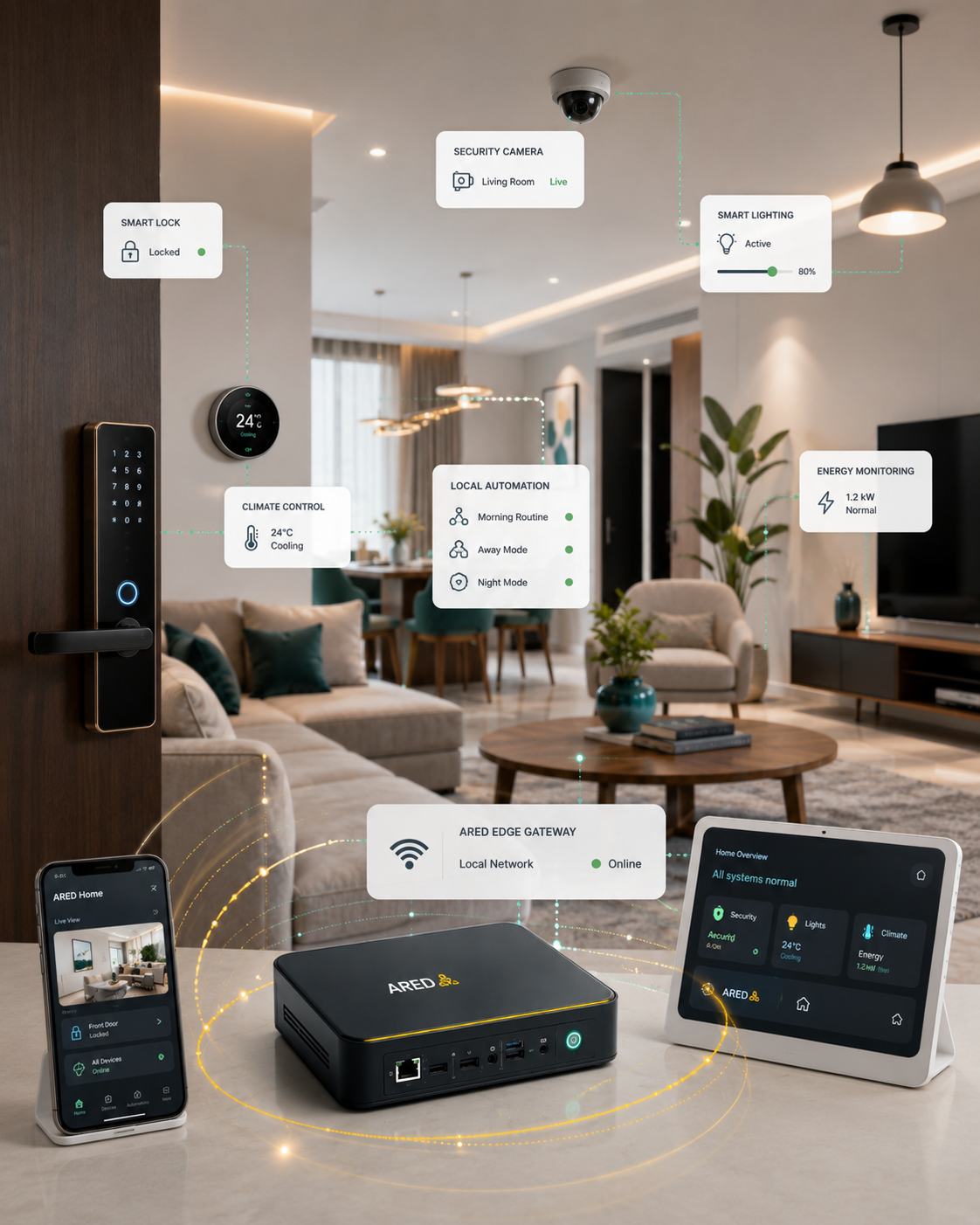
Different hubs, applications and cloud services can create fragmentation, privacy concerns and dependence on continuous connectivity. ARED's direction is to provide one managed local intelligence layer underneath compatible home services.
Lighting, security, energy and sensors can each arrive with separate hubs, applications and management.
Some home functions should be able to respond locally instead of relying on every action traveling to a remote cloud.
The goal is not more gadgets. It is a local platform that can support security, efficiency, comfort, learning and approved wellbeing services.
The technology stays behind the customer outcome.
The ARED gateway is intended to coordinate selected compatible services instead of adding another independent hub for every new home function.
Where supported, local processing can reduce unnecessary movement of sensitive data and allow selected functions to respond locally.
Start with a small set of validated devices or services, then add approved automation, energy, security or AI capabilities as the ecosystem matures.
ARED is hybrid by design. Local-first does not mean cloud-free.
Approved cameras, sensors, automation devices, energy systems and user interfaces create or consume local information.
Provides the local intelligence, application, data and orchestration layer for supported smart-living services.
Use centralized systems for remote access, updates, long-term history or third-party services when they add value.
Capabilities depend on compatible devices, partner integrations, safety requirements and market rollout.
Use compatible cameras and sensors for approved local security and awareness workflows.
Integrate approved energy, solar, battery or appliance data to support local monitoring and automation.
Coordinate compatible lighting, climate and appliance-control workflows through approved interfaces.
Run selected local AI or assistant functions where the hardware and application are validated.
Support approved educational or household content close to the home, including use during connectivity interruptions where designed.
Integrate compatible wellbeing sensors or awareness tools. ARED does not position these functions as medical diagnosis.
Design a repeatable local intelligence layer into new housing projects.
Use a managed edge platform underneath approved connected-home services.
Integrate compatible local security, awareness and sensor services.
Connect approved energy, building and home systems to a local managed platform.
ARED Smart Home is best positioned today as an emerging solution and partnership opportunity. The commercial package should follow validated device integrations, installation playbooks and clear customer outcomes.
Priority collaborators include sensor and home-automation manufacturers, security hardware providers, appliance/energy technology companies and residential developers. The goal is a simple, useful local platform — not a long list of speculative features.
Smart Home should not carry a consumer price until the supported device set, installation scope, service package and support responsibilities are proven.
ARED is looking for partners who can help validate compatible devices, installation models and real smart-living customer outcomes.